Social Customer Service: The ROI of Social Media

Respected marketer Paul Dunay writes in his Buzz Marketing for Technology newsletter that the true ROI of Social Media for B2B marketers is found in what he terms Social Customer Service. I agree and take it one step further — it’s not just the secret sauce for B2B but B2C as well.

Simply put, social customer service is keeping your customers happy. Makes sense, right? And just as applicable to both business and consumer targeted customers. So why do some companies feel that listening to their customers, especially when they are talking about their products or services, is not worthy of serious budgetary (dollars or time) commitment?

The trap is when in-house (or agency) marketers see social media as primarily another distribution point to market the company’s wares. Turning social media ROI into a statistical analysis of views, clicks and conversions misses out on the most valuable aspect of this social science: deepening engagement between your brand and its customers resulting in less customer churn, more customer satisfaction and creation of a viral army of brand evangelists who will praise you among their peers

This is why companies need a social media professional on hand to champion the customer within its walls and represent the company wherever its customers gather online.

Dunay has it right:

“The downside of poor customer service has been well documented on the web more and more people are taking to the web to warn other would be customers of their dissatisfaction so don’t let that be your company! I never read a Social Media case study that started with “we completely ignored this customers issue they were blogging or tweeting about and everything worked out great” in fact it is always the opposite.”

Exactly.

The (Self-Proclaimed) Most Amazing Press Release Ever

The (self-proclaimed) most amazing press release ever written comes from Mitch Delaplane of PitchPoint PR. And while it’s an amusing piece, it calls to mind how much the venerable press release has changed from the days when it was distributed to a closed ecosystem of journalists to entice them to learn more, and in turn write about, the product, service or individual.

Today, the press release is pure and simple content — meant as much (if not more) for the end user to consume as part of his/her daily web-based news gathering process as it is for writers to repurpose.

The rise of the social media press release acknowledges the role search engines play in being the new conveyor of information to the end user. Releases that have the proper number of characters in its headline; include certain keywords in the proper places; use direct quotes and hyperlinks wisely; and incorporate images and video carefully, all get higher placement from search engines and therefore more notice from users.

If your press releases are not optimized for social media, hire a professional with that specific skill-set as part of your permanent communications team. That’s not a “nice to have” it’s a “must have.”

See the release: http://ow.ly/3DQ8z

The Ten Commandments of Social Media Crisis Management

Writing for BuzzBin, Priya Ramesh does a good job listing the Ten Commandments of Social Media Crisis Management, but I think it needs one more.  Here’s Priya’s 10 (condensed by me) and my essential 11th:

1. Thou shalt move at lightning speed: This demands a sense of urgency to react in a matter of hours and not days.
2. Thou shalt build a micro-site to provide 24/7 updates: This serves as THE go-to site for all up-to-date information on the situation.
3. Thou shalt deploy a round the clock Twitter monitoring schedule: Simply by monitoring and responding to tweets, you are letting the audience know their outpour is being heard on social channels.
4. Thou shalt NOT delete negative comments on the crisis: By deleting negative chatter during a crisis, you are only aggravating the situation.
5. Thou shalt train your crisis team on social media: Crisis communication in 140 characters is very different from issuing a press release or calling a press conference.
6. Thou shalt be willing to say “Sorry” openly on the WWW: Get used to openly apologizing on social networks and take full responsibility for the crisis.
7. Thou shalt create hyper-transparency on the crisis situation: The more you are open to sharing information on social networks to build transparency, the better.
8. Thou shalt proactively alert bloggers on PR crises if you can: This is a very powerful tactic to neutralize the negative sentiment online.
9. Thou shalt NOT feed the troll: There will always be a set of constant complainers who thrive on crises and leverage the situation to further badmouth your company –  disengage them.
10. Thou shalt not merely blog and tweet for crisis’ sake but LISTEN and ENGAGE: Companies that demonstrate that they have listened and taken the right action are the ones that maintain a favorable image online.

And here’s an essential additional step from me:

11. Thou shalt own your social media identity: Take steps now to ensure that social media accounts related to your company, its brands and executives are created and already under your control. After the jump,  why this is so important: Read more of this post

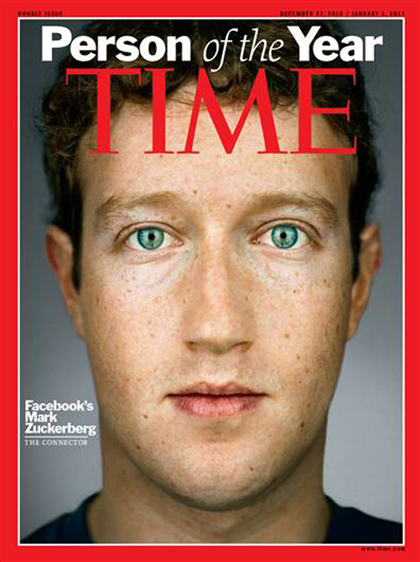
Mark Zuckerberg,TIME Magazine Person of the Year — But Not Mine

Mark Zuckerberg TIME Person of the Year 2010In a year full of the famous and infamous, Facebook chief Mark Zuckerberg is TIME magazine‘s Person of the Year.

While you cannot debate that Zuckerberg and Facebook made news on a global basis in 2010, I don’t agree that his selection was the most worthy.

Let’s talk about impact. True, Facebook is the most impactful social network worldwide, but even with 500 million members, that’s still only about 7% of the world’s 6.9 billion population.  A large number to be sure, but why recognize him now? A hit movie? A killer ‘60 Minutes‘ appearance? The fact that the “enfant terrible” of social media appears to have finally grown up?

Newsworthy, yes, but surely others were more deserving. Love him or hate him, my choice is Julian Assange and his WikiLeaks site who have made a far more serious impact worldwide not only on government and the military, but also on the state of journalism itself. For that matter, strong arguments exist for former BP chairman Tony Hayward or, for group recognition, The Unemployed American. It wouldn’t be the first time a group was the “person”.

Take it from me, a former co-winner of TIME’s Person of the Year (2006).

Updated Feb 4, 2012: My apology to Mark Zuckerberg (among other things) 

Twitter Top 10 Trends 2010 – Hold the Toast

Twitter logoTwitter released its list of the most popular trending topics for 2010 and as I reviewed the top ten, it strikes me how its diversity reflects the widespread interests of Twitter users themselves.

Of the ten, two come from the News Events category (1, 4); one from People (8); two from Movies (3,9); two from Technology (6,7); and three from the World Cup (2, 5, 10):

  • 1. Gulf Oil Spill
  • 2. FIFA World Cup
  • 3. Inception
  • 4. Haiti Earthquake
  • 5. Vuvuzela
  • 6. Apple iPad
  • 7. Google Android
  • 8. Justin Bieber
  • 9. Harry Potter & the Deathly Hallows
  • 10. Pulpo Paul

And while it is surprising that none from the Television category made the Top Ten, Twitter-haters be advised — Toast is nowhere to be found.