A Scorpion, a Frog and an Aflac Duck

By now you’ve heard that Aflac insurance fired comedian Gilbert Gottfried as the commercial voice of its Aflac duck for tweeting insensitive and offensive remarks (since removed) about the disaster in Japan on Twitter.

True, tweets like these  (here are two of 12 issued in total) are insensitive and could be considered offensive:
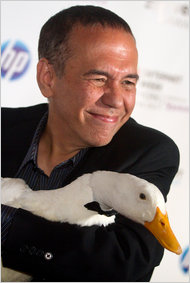
Charles Sykes/SYKEC, via Associated Press“I was talking to my Japanese real estate agent. I said, ‘Is there a school is this area?’ She said, ‘Not now, but just wait.’”

“Japan is really advanced. They don’t go to the beach. The beach comes to them.”

The company stated the tweets were “lacking in humor and certainly do not represent the thoughts and feelings of anyone at Aflac.”

Fair enough, and the fact that Aflac does 75% of its business in Japan is certainly a valid business reason to end their relationship. The company was entirely within its rights — and indeed had no choice — but to do so, even though Gottfried’s voice is not used in the Japanese versions of the ads and most of Aflac’s customers likely never knew that Gottfried supplied the duck’s voice.

Insensitive, offensive and ill-timed. But that describes Gottfried who has a long-held and well deserved reputation of being, as Howard Stern recently put it, “the most foul-mouthed comedian” out there.

Example: Shortly after  9-11, Gottfried was part of a Comedy Central/Friars’ Club roast of Hugh Hefner where no one was in the mood to laugh. There, a joke about his plane having a connection at the Empire State Building was met by catcalls and cries of, “Too soon!” Concluding that it was time for a comedy “Hail Mary”, Gottfried broke into an obscene, graphic, vile, extended version of the recognized “dirtiest joke of all time” – ‘The Aristocrats.’ It is also accepted as the best performance of that joke ever.

And that brings us to the fable of the scorpion and the frog. A scorpion approached a river and Read more of this post

Turning Five On March 21, Twitter Has Room to Grow

Image representing Twitter as depicted in Crun...

Image via CrunchBase

A sneak peek at the results of a new study on social media usage behaviors and trends by Edison Research to be released in the coming weeks titled The Social Habit (see 2009 results), reveals just how ubiquitous the Twitter brand has become.

In a short time, Twitter (turning five years old March 21) has insinuated itself into the American psyche with a whopping 92% domestic awareness. Usage, however, tells another story, with just 8% of Americans Twitter users.

92% awareness; 8% usage. Let’s call this a corollary to the 90:10 rule reflecting passive to active social network users.

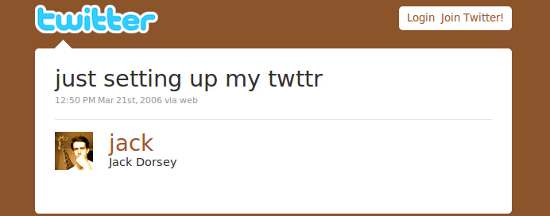
The 1stTweet

The 1st Tweet March 21, 2006

Contrary to concluding that Twitter has been dismissed by the public as being inconsequential or fleeting in nature, it possesses tremendous growth potential over the next several years as awareness leads to acceptance which, for many, will lead to usage as the evolution from Early Adopters to Lead Users to Mainstream Acceptors and Laggards plays its course. You only need to look to the advertising history:

The social network links becoming more and more common in the ads of today, mirror how web site URLs became prevalent just 5 years ago.

Don’t Blame Twitter — Case Study: STRABAG SE

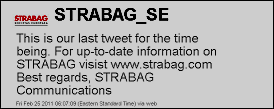
Austrian based STRABAG SE, one of the largest construction companies in Europe with 73,600 employees and annual revenue of € 12.B (both as of fiscal 2010), posted this update on Twitter after 18 months of use —>

In an email to IR Web Report (whose article inspired this blog entry), spokesperson Paula Rhys of STRABAG’s investor relations team said: “We do not see any benefit in using this social media tool for the time being. Stakeholders did not discuss actively with us on Twitter despite our efforts to ask questions.

Now, regular readers of this blog or my Twitter stream know that a recurring theme of mine is that companies need to place the responsibility for its social media initiative in the hands of a social media professional. A quick review of this move by STRABAG underscores this requirement.

The Facts
STRABAG created their Twitter account on August 5, 2009 and issued its first tweet two days later (“Largest construction company in CEE

  • It has issued 146 tweets over the 575 days from inception to the date of this entry (~4/week)
  • It follows 524 people, is followed by 527 and appears on 32 Twitter lists
  • Its bio info is exactly the same as its first tweet (see above)
  • Its profile provides a link to its home page: http://www.strabag.com

The Analysis (aka Why They Were Doomed to Twitter #Fail)
First, let me say that the mistakes STRABAG made are not uncommon when companies apply traditional marketing and communications strategies towards leveraging social media. I do not mean to assign blame to its communications and marketing teams — it’s not their fault — they were simply operating the way they were trained. But, Twitter, and indeed all social media, is a different animal. Here’s what they did wrong: Read more of this post

Of Kenneth Cole; Twitter; and Crossing the Line

“The evil that men do lives after them, The good is oft interred with their bones.”
– from ‘Julius Caesar’ by William Shakespeare

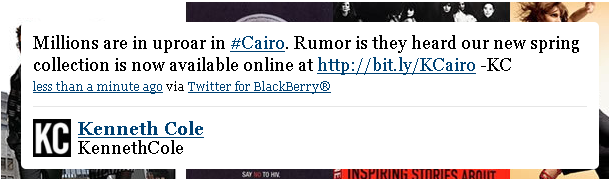
By now you’ve heard about this tweet issued by fashion designer Kenneth Cole where, in an obvious case of insensitivity, he tried to connect the world-changing events in Egypt to his spring line:

Ouch! And for this he has rightfully drawn the scorn of the Web. That’s what he did wrong.  You know it, I know it and he  knows it.

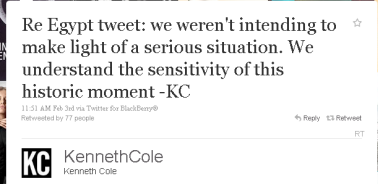
What he did right next was to remove the offending tweet,  but not try to cover it up; instead he acknowledged the mistake and apologized publicly within a few hours:  

When negative reaction persisted, he did so again, more extensively. Still, “the evil lives on”, these days in the form of first page Google search results.

But, as inevitable as that sounds,  mistakes will be made – so create an action plan now for handling the blowback.

Cover-ups Never Work

People always ask me how to remove negative social mentions online. The truth is they can’t be summarily deleted. Manipulating social media to obfuscate the truth never works. I can cite examples. The social space is in many ways self-correcting, and the truth will out. Always. The best tactic: do good things. And get those good things (thought leadership examples; blog entries; positive reviews of personal appearances) published online. Get them in front of key influencers and, this is vital, do everything while maintaining three core principles:

Accuracy; Integrity; Transparency

Social media reputation management does not work any other way. Don’t let the good be interred with the bones of the brand’s or individual’s reputation when crises hit. Be both reactive and proactive.

Of course, the best way to handle a PR crisis is to avoid them in the first place. As a brand, Kevin Cole is known for being socially relevant and supportive of social causes — often in a controversial way. As such, his brand supporters and loyalists will not likely be affected by this social media faux pas compared to those for whom he was an unknown.

In a sense, he’s lucky that it was he who made the intended-to-be-pithy-but-ultimately-offensive remark. Had a social media manager in his company done this he/she’d likely be looking for a new job.

But then again, in the hands of a professional, maybe the mistake would have been avoided.

Full disclosure: In a past life I worked for El Greco Leather, a company owned by Kenneth Cole’s father and run with his two brothers. I never had any direct contact or dealings with Kenneth (though I do wear his shoes)

Twitter: The Not So Angry Bird

I’ve been speaking with a lot of people lately about the role of the social media exec in today’s business world and, of course, the conversation invariably includes Twitter. Even now, almost five years after its launch, many people have misconceptions or negative opinions about Twitter largely based upon a lack of knowledge.

And so when I saw this post on Mediabistro‘s All Twitter blog titled, 3 Things Most People Don’t Understand About Twitter, I thought I’d add a few comments on them as well.

Myth #1: Twitter is a social network: It is not. It is a part of social media, but it is not a social network — it is an information network, backed up by public comments from co-founder Biz Stone. Earlier this month, Twitter finally released its mission statement that stresses that assessment and here’s proof: We all know that Google is the king of the search world, but did you know that the #2 position is held by Twitter? That’s right, more searches are performed on Twitter each month than on Yahoo! and bing, combined.

Myth: It’s just good for one thing: On the contrary, it’s good for many things. Your Twitter is not the same as my Twitter. In fact, my Twitter changes from moment to moment. Sometimes I use it as a communications tool; sometimes a news source; and at others a marketing tool. That’s my Twitter. As we say online, YMMV (your mileage may vary).

Myth: Twitter kills productivity: Is Twitter a time suck? Well, what isn’t? Anything you do takes your time and, as mentioned above, Twitter time can be just as valuable (or not) as any other research or communications activity. The important factor is that it is a customizable experience to be used as little or as much as makes sense. As for banning it, or other social media, from the workplace I’d counsel to tread lightly. Unless you also ban all smartphones from the premises your employees will still spend time on those sites. It is better to make a reasonable social media policy where personal use of social media is akin to personal use of company phones and have supervisors continue to judge their direct reports as they always have: do they get the job done well, on time and with positive influence on their peers.

Connect with me on Twitter @roncasalotti.