Great Infographic on Social Media Use

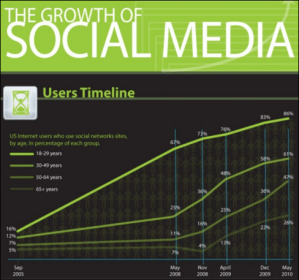
See full infographic after the jumpEveryone likes a good infographic — a chart or visual that conveys important information in a visually compelling way — but not everyone who creates them does it right. I love this one called “The Growth of Social Media” by the good people of Search Engine Journal. A ton of info, such as:

  • If Facebook were a country it’d be the third largest in the world
  • 1 in 4 Americans watches a YoutTube video every day
  • 49% of Twitter users rarely or never check Twitter
  • 80% of companies use social media for recruitment and 95% of those use LinkedIn

And there lots more. See the full infographic after the jump.

Read more of this post

Everything AOL Is New Again, Again

American layout roulette wheel.

Image via Wikipedia

I can’t help it. Maybe it’s because I spent 10 years working at AOL during it’s rise and fall. Maybe it’s just that things happen in cycles. Regardless, when I saw this headline today it made me think of something I’d written about previously:

StumbleUpon passes Facebook in US referral traffic

So what does this have to do with AOL? First, some background for those of you who have never been an AOLer. Navigation within the walled garden of AOL content was aided by the use of shortcuts known as Keywords. Want to jump directly from the Welcome Screen to content regarding vacations? Enter keyword: Travel.  Want to go from there to see how your favorite team did last night, use Keyword: Sports. With both major and sub-categories there were literally hundreds (if not thousands) of keywords on AOL.

So what does this have to do with StumbleUpon passing Facebook as the number one referer on the ‘Net? Well, at AOL we were privy to the list of most popular keywords (as determined by user clicks), and invariably every month positioned near the top was Keyword: Random.

Enter “random” in the keyword box and a roulette wheel would appear. Click it to spin and when it stopped you’d be taken to a random page somewhere on AOL. Some pages were great, some not so great. But people loved the, well, randomness of the result, something I refer to today as serendipitous discovery“– where you (literally) stumble upon content you previously had no knowledge of.

It worked back then for AOL, and to StumbleUpon’s benefit it still works today.

♫… No need to remember when
‘Cause everything old is new again …♫

STATS INTERESTING: Social Media By the Numbers

Social media is NOT about stats. Too often, companies put too much emphasis on the numbers (how many followers; how many “likes”, etc.) at the expense of ignoring the true value that social media provides.

And even though I believe in the old adage, “There are lies; there are damnable lies; and there are statistics”, I recognize that having a few quick stats on hand can help you gain support for social media — so here are a few:

  • 5 percent of online shoppers note that social media influenced them to visit a retailer’s website (Foresee)
  • 82 percent of 18-29 year olds utilize a form of social networking (Pew)
  • 40% of corporate Twitter accounts engage in some kind of customer service (Burson-Marsteller)
  • In 2011 marketers will increase their social media usage by 75 percent (Brian Solis)
  • 48 percent of consumers combine social media and search engines in their buying process (GroupM)
  • Of all social networks, YouTube has the highest Net Promoter Score with 50 percent of users saying they would recommend it to a friend (MarketingProfs)
  • ~140 Million Tweets are sent each day (Twitter) (update: July 2011 ~200 million/day)
  • 24 percent of adults have posted a review of a product they have purchased (HubSpot)
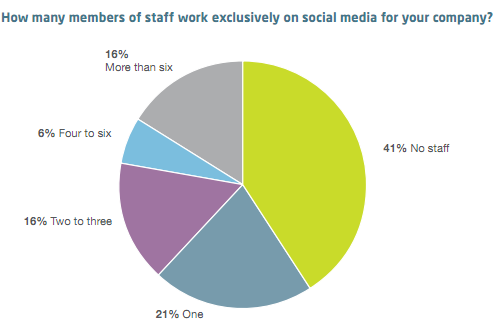
  • 41 percent of the companies report that there is no staff dedicated to social media (Useful Social Media) (see graphic)
  • 35 percent of small businesses utilize social media in their marketing mix (eMarketer)
  • Facebook expects to bring n $4.05 billion in ad revenues this year (eMarketer)
  • One out of every six minutes spent online is on a social network (comScore)
  • 73 percent of the US internet population visits Facebook each month (comScore)
  • 62 percent of Facebook users between 35-54 years of age have liked a brand (eMarketer)
  • 47 percent of journalists will use Twitter as a source for a story (Digital Journalism Study)
  • The average media site integrated with Facebook has seen a 300 percent increase in referral traffic (Search Engine Land)
  • 61 percent of Facebook users who have liked a brand note that they are more likely to purchase from that brand (AllFacebook)
  • 96 percent of Americans use Facebook (Business Insider)
  • 46 million Americans check their social media profiles daily (Edison Research)
Sometimes, having a handy stat or two can help you build support for your social media initiatives. Then, once they’re on board you can really open their eyes to the value of social media.
For more interesting social media stats, see the source article for this entry: Social Media Stats for the C-Suite by  Jeff Esposito

Happy 100th IBM – and a One Word Lesson for Social Media

Image representing IBM as depicted in CrunchBase

Image via CrunchBase

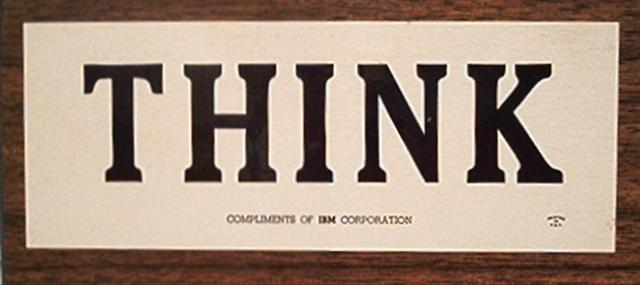
Light the candles (and notify the Fire Marshall) on the cake and sing “Happy Birthday” to IBM as it celebrates its 100th birthday. Despite its many technological accomplishments including the revolutionary punch cards; electric typewriters, mainframes and personal computers, its most significant contribution to social media use may be its iconic company slogan — “THINK”.

On June 16, 1911 four companies merged into the Computing Tabulating Recording Corporation in Endicott, NY creating one of the great American corporations, renamed in 1924 as International Business Machines, IBM. Three years later its iconic leader, Thomas J. Watson, instituted the one-word slogan that both encourages and cautions – THINK.

And that’s the social media lesson for brands and individuals today. Before you send that photo… before you post that angry rebuttal… before you denigrate others (no matter how well deserving)… before you tweet that knee-jerk reaction that , at the time, you are sure is justified… THINK.

Think about how what you send may be received. Think about how what you say can be interpreted. Think about whether what you are about to do maintains accuracy, integrity or transparency — or — just lowers you to the same level as the muckrakers and mudslingers.

Too often, brands have been tarnished, careers ended or major revenue lost, due to the failure to employ a “digital count-to-ten” before publishing on the Web.

It’s not enough being right. It’s not enoughbeing technically correct. In social media, as in all marketing and indeed much of life itself, it’s all about how what you do is perceived. So before you post, tweet, like or digg…
Accuracy; Integrity; Transparency — A Social Media Lesson For Anthony Weiner (and Everyone)

“… but at the length truth will out.”
– from ‘The Merchant of Venice’ by William Shakespeare

Those words, the bane of politicians, ad men, PR flacks, marketing gurus, titans of business and wayward spouses throughout the ages, are as true today as they were when written 415 years ago.  But instead of waiting for a pamphlet to be printed on a 16th Century mechanical press (the origin of the word “Press” regarding news) and hand delivered, read aloud or nailed on a church door, what happens today can spread  across the globe via social media before the next sunrise.

Those following me for a while know that I am a social media professional who strongly suggests to companies, organizations and yes, politicians, that to take advantage of the vast benefits social media has to offer while avoiding its pitfalls you need two things: 1) to conduct your social media (both brand related and personal use) with accuracy; integrity and transparency and, 2) to consult with or have on board a social media professional to lead the way.

Rep Anthony Weiner courtesy ReutersWhich brings us to U.S. Rep. Anthony Weiner (D-NY), who shorts(sic)-circuited his political plans by engaging in questionable social media and phone-based relationships. For a politician — (one of the few professions where you are expected to always be on the job), this can be a career-breaker causing us to collectively sigh, “What were you thinking?” Regardless, let’s take a look at what he admittedly did and the social media pillars he ignored:

Read more of this post