STATS INTERESTING: Social Media By the Numbers

Social media is NOT about stats. Too often, companies put too much emphasis on the numbers (how many followers; how many “likes”, etc.) at the expense of ignoring the true value that social media provides.

And even though I believe in the old adage, “There are lies; there are damnable lies; and there are statistics”, I recognize that having a few quick stats on hand can help you gain support for social media — so here are a few:

  • 5 percent of online shoppers note that social media influenced them to visit a retailer’s website (Foresee)
  • 82 percent of 18-29 year olds utilize a form of social networking (Pew)
  • 40% of corporate Twitter accounts engage in some kind of customer service (Burson-Marsteller)
  • In 2011 marketers will increase their social media usage by 75 percent (Brian Solis)
  • 48 percent of consumers combine social media and search engines in their buying process (GroupM)
  • Of all social networks, YouTube has the highest Net Promoter Score with 50 percent of users saying they would recommend it to a friend (MarketingProfs)
  • ~140 Million Tweets are sent each day (Twitter) (update: July 2011 ~200 million/day)
  • 24 percent of adults have posted a review of a product they have purchased (HubSpot)
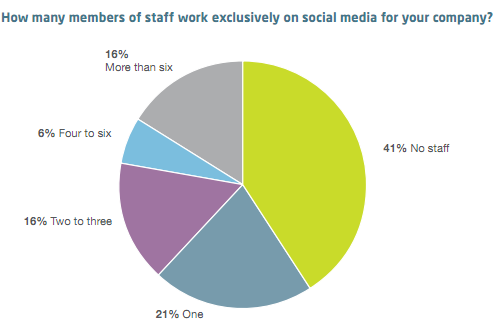
  • 41 percent of the companies report that there is no staff dedicated to social media (Useful Social Media) (see graphic)
  • 35 percent of small businesses utilize social media in their marketing mix (eMarketer)
  • Facebook expects to bring n $4.05 billion in ad revenues this year (eMarketer)
  • One out of every six minutes spent online is on a social network (comScore)
  • 73 percent of the US internet population visits Facebook each month (comScore)
  • 62 percent of Facebook users between 35-54 years of age have liked a brand (eMarketer)
  • 47 percent of journalists will use Twitter as a source for a story (Digital Journalism Study)
  • The average media site integrated with Facebook has seen a 300 percent increase in referral traffic (Search Engine Land)
  • 61 percent of Facebook users who have liked a brand note that they are more likely to purchase from that brand (AllFacebook)
  • 96 percent of Americans use Facebook (Business Insider)
  • 46 million Americans check their social media profiles daily (Edison Research)
Sometimes, having a handy stat or two can help you build support for your social media initiatives. Then, once they’re on board you can really open their eyes to the value of social media.
For more interesting social media stats, see the source article for this entry: Social Media Stats for the C-Suite by  Jeff Esposito

My New York: A Not Atypical Night in NYC

Catch Me If You Can PlaybillJust another Thursday night in New York City in July.

Went to the TKTS booth in Times Square and picked up discounted tickets for ‘Catch Me If You Can‘ at the Neil Simon theater starring Aaron TveitNorbert Leo ButzKerry Butler and Tom (TV’s “Luke Duke“) Wopat.

Courtesy IMDB.ComOn the way to the theater, passed Sutton Foster walking on Broadway to her gig in ‘Anything Goes‘. Dressed in jeans and a T-shirt with no make-up — still beautiful.

Matthew BroderickAprés theater, dinner at Angus McIndoe Restaurant (try the burgers ans McIncheese) on W 44 Street with Matthew Broderick (OK, well, he was at the table next to me).

I love NY.

Calling the News Corp. Situation a “PR Problem” Is Wrong

Rupert Murdoch - World Economic Forum Annual M...

Image by World Economic Forum via Flickr

I keep seeing the situation with Rupert Murdoch’s (photo right) News Corp. and the circumstances that led to its closing ‘The News of the World‘ (“NotW”) after 168 years referred to as a “PR problem.” That is just wrong.

Certainly, the unethical hacking activity into private citizen’s email and voicemail by NotW journalists is worthy of both scorn and retribution, legal and otherwise, but calling it a PR  problem implies that good PR practices could have mitigated or even prevented the consequences News Corp. continues to face. And that’s not true.

As with any crisis response, News Corp. needs to follow the Five A’s of crisis management (amended to six by me):

  1. Assess
  2. Admit
  3. Address
  4. Atone
  5. Adapt
  6. Abridge

No amount of “good PR” could’ve saved NotW, and it remains to be seen what the ultimate ramifications are for News Corp. It’s not a PR problem— it’s a PR issue.

Let’s not confuse the two. 

First Ever White House Tweetup? More Like an Old AOL Auditorium Event

Jack Dorsey and President Obama courtesy BET.comCommander in Tweet? Not quite. Don’t take me wrong, I’m in favor of anything that promotes social media and incorporates it into the mainstream. But, in an attempt to capitalize on the “now”, the White House stumbled in both the promotion and execution of the “first ever White House Tweetup”, and inadvertently paid homage to yet another online feature made prominent by old AOL.

By definition and popular acceptance, a Tweetup is a F2F (face to face) meeting of people who interact primarily online. Hosted by Twitter co-founder Jack Dorsey, this was admittedly not a Tweetup, but more of a Twitter Press Conference. Dorsey stated:

“Neither the President or I know the questions that will be asked today.  That decision is driven entirely by the Twitter users.”

Well, I guess that depends on your definition of “driven.” True, any Twitter user could submit questions via the service by appending the hashtag #AskObama to their tweet. And sure, neither Dorsey nor Obama knew precisely to what the questions would pertain. However, the submissions were previewed, reviewed. culled, vetted and ultimately selected by at least two levels of editors: First, a “team of seasoned Twitter users” helped pick the questions that would be considered. Next, Twitter assembled “eight curators” to further subjectively winnow the field to those they considered appropriate.

And so the questions, while submitted by Twitter users, were carefully selected to reflect a limited number of acceptable topics. More than once, Dorsey mentioned that the questions were coming in “real time”. Hmm, did they not get enough participation beforehand to fill the approximately 20 or so questions and comments fielded in the 1 hour eight minute event? And what luck that three of the questions were submitted by a White House journalist, Speaker of the House Boehner and the President himself, making at least 15% of the questions not submitted by John Q. Tweeter.

So why is this like old AOL? Read more of this post

Everything AOL Is New Again

Image representing AOL as depicted in CrunchBase

Image via CrunchBase

♫… When trumpets… were mellow
And every gal only had one fellow
No need to remember when
‘Cause everything old is new again …♫

I have a soft spot in my heart for AOL. Shortly after getting my first PC in 1994, I joined all of the Internet portals of the day on a trial basis: Prodigy; CompuServe; Genie; Imagination but ended each subscription at the end of the free period except for one: AOL, because of what I later came to know as Community. I quickly got hooked on building relationships with like-minded people without regard to geographic or societal boundaries. In other words, social networking.

In fact, I loved it so much I became a beta tester for AOL 1.5 (when it had 500K members) onward, then a volunteer, then a contractor and finally in 1997, a paid  employee. During the next 10 years I rode the crest of AOL’s rise to the largest portal in the world (with 35 million paid members) as well as its accelerated denouement.

Blame management; blame the ill-conceived and worse executed merger with “old media” Time-Warner; blame whomever or whatever you wish for AOL’s fall from grace. But the fact is, AOL was a trailblazer in many ways. So, it’s both satisfying and frustrating to see current digital companies (including the “new” AOL) turning back to its concepts and features.

♫… Get out your white suit, your tap shoes and tails
Let’s go backwards when forward fails …♫

Back then, AOL based programming on a TV network model comprised of major content categories called channels, with user engagement provided by supporting community teams. About 20 or so major channels, provided both content and community. And so, it was good to see TechCrunch (itself an AOL “channel”) report today, “AOL Consolidates 53 Brands Down To 20 “Power Brands” in an effort to consolidate both content and advertising inventory. See the resemblance?

But it wouldn’t be a trend if only New AOL were doing this. The NY Times reported on Monday about a growing trend in many large organizations, “Companies Are Erecting In-House Social Networks“. Organizations are employing private networks, or intranets, utilizing social networking to improve communications and increase associate engagement. Great idea! Of course, AOL  provided parallel AOL private networks for a fee to companies and organizations way back in 1997 – fourteen years ago.

Yes, AOL fell behind on many fronts, especially the migration to broadband access and the open Internet as well as products such as blogs and user-generated video. And, ultimately, it has no one to blame for its current situation other than itself.

 But its important to give AOL credit where due.

♫… Don’t throw the pa-ast away
You might need it some rainy day
Dreams can come true again
When everything old is new again …♫

(Lyrics: ‘Everything old Is New Again”  – Peter Allen)