Social Media: An Essential Recruitment Tool

You’ve heard how companies are increasingly utilizing social media to recruit new associates, but what exactly does that mean? Jobvite‘s 2011 survey provides a look at which social networks recruiters and hiring managers use to find and assess prospective employees.

How Many Businesses Use Social Media?
Social Recruiting Plans

The answer is just about every company does, with almost 90% responding that they either already do or plan to use social media as a recruitment tool.

This makes sense, as more job seekers search for positions via digital means. Early in my career I poured over pages of job listings in the Sunday New York Times classifieds section weekly. Today’s digital route is much more efficient in finding opportunities and marketing themselves online.

Which Social Networks Are Most Important?
Social Networks for Recruiting No surprise here, LinkedIn, long known as the social network of professionals and recruiters, gets the most play with 86.6% of respondents utilizing that network. Launched in May 2003 as a business-related social network, LinkedIn’s 120 million members are a prime audience for talent recruiting and vetting.

What’s impressive are the numbers posted by Twitter and Facebook. Dismissed by many businesses, they provide a large, often different recruitment pool, with insight into prospects’ character via status updates, photos and affiliations.

When Do Companies Look at Your Social Footprint?
Use of Candidate ProfilesAnd as you can see, you’ve got an almost three out of four chance that the company you’ve applied to will search out your online presence – even if you do not provide them with their links.

Advice: Do your own social media audit. Perform a Google search on your own name and see what is returned. Check out all of your mentions to see which you should take down, modify or request a correction.

Remember: What happens online, stays online — for all to see or discover. 

When Your PR Problem is Your PR Agency

Image representing Wikipedia as depicted in Cr...

A friend of mine got a job in the PR department of a large corporation, one that prides itself on the veracity of its products. It wasn’t long before s/he was pressured to “fix” information on Wikipedia that the company felt reflected poorly on its management. This is a “PR Fail.” Here’s why:

What critics and skeptics fail to realize is that Wikipedia is self-policing, with published policies and standards  — in particular regarding Conflicts of Interest (COI) — and about 100,000 regular editors who add or review. Try to game the system? You’ll succeed short-term but, eventually, you’ll be found out. The latest case in point: PR firm Bell Pottinger.

One of the largest lobbying firms in the UK, Bell Pottinger is under scrutiny for allegedly editing entries about its clients, violating Wikipedia’s COI (see article links, below). Worse, it apparently sees this as “business as usual”, stating:

I can’t see any bad headlines for our clients,” he told the BBC. “You won’t find anybody, including journalists, who doesn’t do exactly the same thing.” – Lord Bell, Chairman 

I disagree. Every client involved will suffer damage to its reputation. What Lord Bell fails to comprehend is that social media is a self-correcting organism. There’ll always be someone with the time and resources to ferret out the truth. Attempts to misrepresent or obfuscate information get discovered and the blowback is worse than facing the facts from the start.

This concept is nothing new. In 1596, Shakespeare wrote: “but at the length truth will out.” And, in a quote generally attributed to Abraham Lincoln, 1858, “you cannot fool all of the people all of the time“. My advice to organizations and individuals alike, is to conduct social media with accuracy, integrity and transparency. That’s how it works.

As for my friend, s/he left that company over a year ago, in part because of the lack of support for social media done right. But the all-too-often encountered attitude of PR bigwigs that social media is something to “handled” persists. So choose your digital PR firm wisely.

Oh, and that old saw about all PR is good PR? Hardly.

Related articles

When to Say “No” to Your Social Media Marketers

See photo credit belowMore and more people are calling themselves social media marketers these days,  so how do you know the one you are working with is giving you good advice?

As always, my recommendation is to first hire a social media professional (someone employed in social media for at least five years) as your in-house guide, watchdog and subject matter expert. Until then, here are four red-flag warning signs that you’re getting bad advice from your social media marketer: Read more of this post

Blog Action Day 2011 – Food, For Thought

Refugees in EthiopiaToday, October 16, 2011, is global Blog Action Day where bloggers from all over the world blog about a singular topic and this year, falling on World Food Day, it’s food (or lack thereof). (Ed. note: 2011 participation: 2,710 bloggers located in  109 countries).

As I write this entry, one of my daughters, Adriane, is flying to Ethiopia as part of a United Nations Foundation global health observation team. Situated between the Sudan to the west and Somalia to the east, I hope she has a safe, informational and inspirational journey.

Ethiopia has the dual distinction of being both besieged by famine, poverty, health crises (TB, Malaria; HIV/AIDS), the worst drought in 60 years as well as the added burden of refugees arriving daily from its neighbors.

The United Nations defines famine as a region or country where:
• At least 20 percent of households face extreme food shortages
• Acute malnutrition affects more than 30 percent of the population
Malnutrition leads to at least two deaths per 10,000 people every day

Ethiopia easily qualifies. There, as elsewhere in the famine-torn  Horn of Africa, foreign aid is essential to bringing relief to this humanitarian crisis.

What YOU can do to help
Contribute to a reputable disaster relief organization. The American Institute of Philanthropy rates a list of charities that best help East Africans. So, the next time you push yourself away from the dinner table, complaining that you “ate too much,”pick one, donate and think of those who suffer hunger everyday.

Until then, chew on this for a while

Click here for more Global Blog Day 2011 entries. On Twitter search #bad2011

Of Jobs, Jobs and Social Media as Disruptor

Three points I’d like to touch upon:

  1. Jobs, Steve Jobs, that is. The passing of a tech giant.
  2. Jobs, lack thereof, that is. And bringing socio-economic change via protest.
  3. The job social media has as disruptive agent, and the blame it doesn’t deserve.

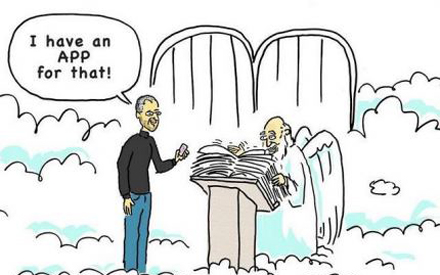
I was saddened to hear of Steve Job’s passing last week. Not as a Mac fanboi; I have always used Windows-based PCs, have an Android smartphone and except for a video iPod none of my gadgets begin with a lower-case “i”. But there is no denying his greatness as a tech visionary and pioneer. My Facebook post acknowledging his transition said it all:

When we were young, we learned about the great explorers: Magellan; Balboa; da Gama and later Lewis and Clark; Byrd and Amundsen. And the great inventors: Da Vinci; Franklin; Marconi; Babbage. Steve Jobs was a little of them all.

Jobs, and the lack thereof. Mark these words: More change comes about in this country by protest than by working within the system. Think about it. Women’s suffrage in the U.S. culminating in their right to vote in 1920; the Civil Right’s Movement’s victory in 1964; the end of the Viet Nam war, until last week the longest war in U.S. history; equal marriage rights and military rights And now we have Occupy Wall Street, sounding the clarion for increased employment and narrowing the gap between the haves and have-nots by exercising their constitutional right to free speech and assembly. You may not agree with what they’re saying, but you must admire the way they’ve made themselves heard. Their movement has spread to other cities across the U.S. The Arab Spring has given way to the American Autumn.

Which brings us to social media’s job as disruptive agent. They key to this is, social media is not the causal factor for disruption. It is a tool. Like the telephone (and cell phone) before it, the radio before that and the newspapers even before that. Silencing, censoring or otherwise attempting to control social media is a losing proposition.

Riots in London? Squatters on Wall Street? Don’t blame social media for fomenting the masses. It is simply a tool like the ones before it. Instead, look to cure the disease, not the symptom.