Happy 6th Birthday Twitter, But Who’s On First?

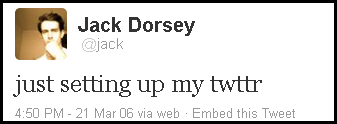
It’s Twitter‘s 6th birthday today (seems like we’ve been talking about it forever) and as it passes its 500 millionth user it’s a good time to think about who was on Twitter first. Now, the recognized first public tweet is from Twitter co-founder Jack Dorsey, who at 4:50 PM tweeted “just setting up my twttr“. Short and sweet, right, with the trendy Web style of the day: no vowels. Very cool, Jack, very cool.

But, some have confused it with a tweet from co-founder Biz Stone or one by the third member of the Twitter triumvirate  Evan Williams  and no wonder — they tweeted the exact same thing.
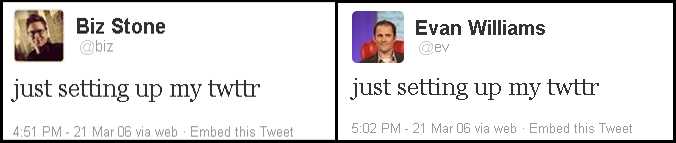
The first tweets of @BIZ and @EV

OK, so the three founders got together and in a show of solidarity coordinated their “first” tweets. But it doesn’t stop there. That same day six years ago it seems like everyone working on the Twitter product sent their first tweets, and at least 45 of them tweeted identically as the founders.

So, while Jack gets credit for being first, he loses points in my mind for originality (as if that matters to him) but he does get points for one first: he started the first “trending topic” in Twitter history.

They say you never forget your  “first“, so here’s mine:

ron casalotti's first tweet

I know, hardly Shakespearean. So tell us, what was your first tweet?

Another Great Infographic on Social Media Use

Sixty seconds in social media smallYou hear it all the time. “Social media has arrived”, Social media is not going away”. “Social media must be a part of everyone’s (individual and businesses) online live” but what does that mean. Last August I commented on social media use at that time. So just how much has it grown?

The good folks at socialjumpstart.com compiled stats on what happens in social media — every minute.  The numbers are astounding, and of course are constantly in flux.  So take a look at their infographic (and note the updates at the bottom):

Every 60 seconds in social media

Updates:
Foursquare has 2x as many check-ins now ~10K per minute
A Stumbleupon representative told VentureBeat the company now does 25,000 stumbles per minute

Social Media Week 2012: Love, Personalization and the Death of Serendipity


Ah, love. Each February 14 we celebrate all things love in remembrance of St. Valentine, a priest who (literally) lost his head over the emotion.  And so, by the powers of the Roman god Cupid; the Greek god Eros; and the consumer goods god Hallmark, we enjoy love found, curse love lost and are hopeful for love to come.

The logo for Love@AOL

Love@AOL - one of the first online dating sites

For me, it also brings back memories of my first “real” job in social media, as a Community Manager at AOL for one of its largest channels, Love@AOL. Launched as a Valentine;s Day special feature in 1996, it did so well that it became a permanent channel, with (at the time) the largest collection of online dating profiles featuring the newest innovation of the day — photos! Simply put, people — even online —  expressed a need to connect, to be social.

Fast forward to yesterday in New York City at the Third Annual Social Media Week New York. In his keynote speech titled ‘Top 2012 Trends in Social,  JWT CEO David Eastman pointed out that four key operators own almost all of the information about you  online. He called them “GAFA” (pronounced “gaffa”), they are: Read more of this post

Happy Birthday Facebook and an Apology to Mark Zuckerberg

the facebook original welcome screen

Facebook's home screen - 2004

Late afternoon eight years ago today (February 4, 2004), in a small room at Harvard University, Mark Zuckerberg flipped a switch and TheFacebook.com went live. Did he know he created a revolutionary platform that would help define the term social media? Hardly. As reported by The Harvard Crimson five days later, the Mark Zuckerberg of then is not much different from the Mark Zuckerberg of today: talented, impatient and cocky.

Having come off creating Facemash.com, his take on the popular “Hot or Not“site where people submit their photo for public judgment (except that he hacked the photos of Harvard students from the schools records resulting in student backlash), he turned his talents towards a Friendster type site — but one based upon “weak tie” connections like school; dorm residence; subject classes rather than a desire to find a date (or mate).  Perceiving the University’s attempt to create a universal face book as moving too slow, he wrote the code for TheFacebook in his dorm room in one week. Talented; cocky; impatient.

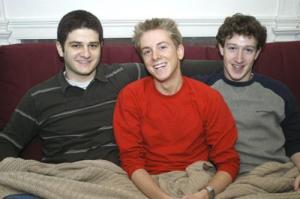
Facebook creator Mark Zuckerberg '06 (right) credits his roommates, Dustin A. Moskovitz '06 and Christopher R. Hughes '06 (left and middle) as the site's social directors.Facebook creator Mark Zuckerberg '06 (right) credits his roommates, Dustin A. Moskovitz '06 and Christopher R. Hughes '06 (left and middle) as the site's social directors.

Facebook creator Mark Zuckerberg '06 (right) credits his roommates, Dustin A. Moskovitz '06 and Christopher R. Hughes '06 (left and middle) as the site's social directors.

After five days TheFacebook had 650 subscribers. Just eight short years later, it counts over 845 million worldwide registrants.  Early on, Zuckerberg rejected an offer from Friendster to sell for $10 Million just a few months after going live. A bold move for a college sophomore.

From the Harvard Crimson 2004 article:
“While Zuckerberg promised that thefacebook.com would boast new features by the end of the week, he said that he did not create the website with the intention of generating revenue. “

In 2008, he resisted Yahoo!‘s offer of $1 Billion (a move many thought foolish). This past week, Facebook filed the paperwork for a $5 Billion public offering that would value the company at between $750 and $100 Billion.

And so I owe Mark Zuckerberg an apology. In 2010, TIME Magazine named him Person of the Year. I wrote an entry at the time stating that it was not the best choice available (see Mark Zuckerberg,TIME Magazine Person of the Year — But Not Mine). But with a 28% ownership stake, Zuckerberg stands to be worth $28 Billion. Yes, that’s billion, with a “B”. Obviously, I was wrong in 2010 and for that I apologize.

I hope he’ll forgive me.

A New Year, But Same Rules for Social Media PR

Image courtesy of the Association of Web Design Professionals2011 was the year in which social media gained wider acceptance as a viable business tool. But in many ways th new year finds the chasm between Marketing and Communications over its use has grown wider.

I’ve written before about the ultimate goal for social media within the enterprise (see “Who Owns Social Media? Ultimate Answer: The Opposites”), but at the start of 2012 it seems (according to the job openings I have observed) that social media marketing is taking command, with calls for professionals experienced in social and viral marketing campaigns ruling the day.

So, when I found this article, The Do’s and Don’ts of Using Social Media in Crisis Communications, I noticed that despite the crisis communications spin of the headline the advice listed makes good sense for any company looking to leverage social media for Communications/PR. Briefly:

Dos
Accept social media as an ongoing tool; create a social media policy; trust and use your staff; plan on who and how to handle crisis communications; keep social media social – participate in the conversation; be honest; always think of your image.

Don’ts 
Try to ban social media use company wide – it won’t work; talk at you audience – engage with them;  try ti spin the message – insincerity is magnified (and readily apparent) online; keep your associates in the dark — keep them apprised and energized; mix corporate social media accounts with associates’ personal ones – accidents do happen.

Of course, the biggest “Do”: engage in social media. It’s a valuable cross-discipline tool for your entire organization.

image credit: association of web design professionals

Related articles