Twitter: The Not So Angry Bird

I’ve been speaking with a lot of people lately about the role of the social media exec in today’s business world and, of course, the conversation invariably includes Twitter. Even now, almost five years after its launch, many people have misconceptions or negative opinions about Twitter largely based upon a lack of knowledge.

And so when I saw this post on Mediabistro‘s All Twitter blog titled, 3 Things Most People Don’t Understand About Twitter, I thought I’d add a few comments on them as well.

Myth #1: Twitter is a social network: It is not. It is a part of social media, but it is not a social network — it is an information network, backed up by public comments from co-founder Biz Stone. Earlier this month, Twitter finally released its mission statement that stresses that assessment and here’s proof: We all know that Google is the king of the search world, but did you know that the #2 position is held by Twitter? That’s right, more searches are performed on Twitter each month than on Yahoo! and bing, combined.

Myth: It’s just good for one thing: On the contrary, it’s good for many things. Your Twitter is not the same as my Twitter. In fact, my Twitter changes from moment to moment. Sometimes I use it as a communications tool; sometimes a news source; and at others a marketing tool. That’s my Twitter. As we say online, YMMV (your mileage may vary).

Myth: Twitter kills productivity: Is Twitter a time suck? Well, what isn’t? Anything you do takes your time and, as mentioned above, Twitter time can be just as valuable (or not) as any other research or communications activity. The important factor is that it is a customizable experience to be used as little or as much as makes sense. As for banning it, or other social media, from the workplace I’d counsel to tread lightly. Unless you also ban all smartphones from the premises your employees will still spend time on those sites. It is better to make a reasonable social media policy where personal use of social media is akin to personal use of company phones and have supervisors continue to judge their direct reports as they always have: do they get the job done well, on time and with positive influence on their peers.

Connect with me on Twitter @roncasalotti.

Social Customer Service: The ROI of Social Media

Respected marketer Paul Dunay writes in his Buzz Marketing for Technology newsletter that the true ROI of Social Media for B2B marketers is found in what he terms Social Customer Service. I agree and take it one step further — it’s not just the secret sauce for B2B but B2C as well.

Simply put, social customer service is keeping your customers happy. Makes sense, right? And just as applicable to both business and consumer targeted customers. So why do some companies feel that listening to their customers, especially when they are talking about their products or services, is not worthy of serious budgetary (dollars or time) commitment?

The trap is when in-house (or agency) marketers see social media as primarily another distribution point to market the company’s wares. Turning social media ROI into a statistical analysis of views, clicks and conversions misses out on the most valuable aspect of this social science: deepening engagement between your brand and its customers resulting in less customer churn, more customer satisfaction and creation of a viral army of brand evangelists who will praise you among their peers

This is why companies need a social media professional on hand to champion the customer within its walls and represent the company wherever its customers gather online.

Dunay has it right:

“The downside of poor customer service has been well documented on the web more and more people are taking to the web to warn other would be customers of their dissatisfaction so don’t let that be your company! I never read a Social Media case study that started with “we completely ignored this customers issue they were blogging or tweeting about and everything worked out great” in fact it is always the opposite.”

Exactly.

The Ten Commandments of Social Media Crisis Management

Writing for BuzzBin, Priya Ramesh does a good job listing the Ten Commandments of Social Media Crisis Management, but I think it needs one more.  Here’s Priya’s 10 (condensed by me) and my essential 11th:

1. Thou shalt move at lightning speed: This demands a sense of urgency to react in a matter of hours and not days.
2. Thou shalt build a micro-site to provide 24/7 updates: This serves as THE go-to site for all up-to-date information on the situation.
3. Thou shalt deploy a round the clock Twitter monitoring schedule: Simply by monitoring and responding to tweets, you are letting the audience know their outpour is being heard on social channels.
4. Thou shalt NOT delete negative comments on the crisis: By deleting negative chatter during a crisis, you are only aggravating the situation.
5. Thou shalt train your crisis team on social media: Crisis communication in 140 characters is very different from issuing a press release or calling a press conference.
6. Thou shalt be willing to say “Sorry” openly on the WWW: Get used to openly apologizing on social networks and take full responsibility for the crisis.
7. Thou shalt create hyper-transparency on the crisis situation: The more you are open to sharing information on social networks to build transparency, the better.
8. Thou shalt proactively alert bloggers on PR crises if you can: This is a very powerful tactic to neutralize the negative sentiment online.
9. Thou shalt NOT feed the troll: There will always be a set of constant complainers who thrive on crises and leverage the situation to further badmouth your company –  disengage them.
10. Thou shalt not merely blog and tweet for crisis’ sake but LISTEN and ENGAGE: Companies that demonstrate that they have listened and taken the right action are the ones that maintain a favorable image online.

And here’s an essential additional step from me:

11. Thou shalt own your social media identity: Take steps now to ensure that social media accounts related to your company, its brands and executives are created and already under your control. After the jump,  why this is so important: Read more of this post

P&G Shifts Ad Dollars from Soaps to Social

Further proof that social media is here to stay:

P&G info on WkipediaProctor & Gamble, the consumer products giant for whom the term “soap opera” was coined, is dropping its advertising on soap operas after 77 years, and shifting their ad dollars to Twitter, Facebook & YouTube.

It’s enough to make a social media guy like me jump for Joy.

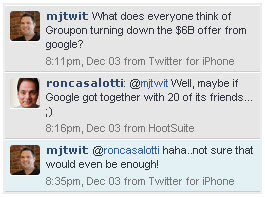
Groupon Rejects $6 Billion Google Offer

Groupon Rejects $6 Billion Google OfferFull article at All Things Digital