Of Failure and Redemption: When ‘Twit’ Happens


Social media and politics were made for each other. After all, when politicians get on their soapboxes, typically labeled CBS, NBC, ABC, CNN, FNN, et. al., the masses get on theirs named Facebook, LinkedIn, and yes, the insta-poll of all social media, Twitter. Here are two lessons for effective social media management– pre and post crisis.

By now, you’ve heard of KitchenAid‘s unfortunate social media faux-pas. During one of the biggest media events in the past four years this obviously unintended ugly tweet was issued from the@KitchenAid Twitter account: I say unintended because from the moment I saw the tweet, as someone who has manned multiple social media accounts for employers and clients, I knew exactly what happened.
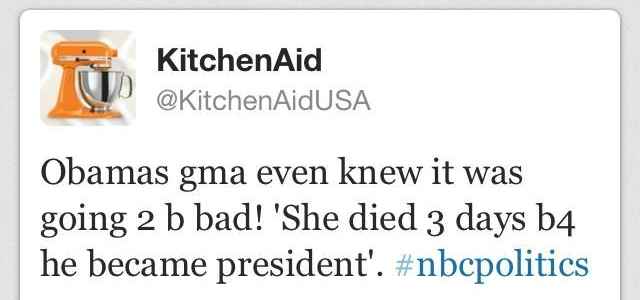
Just about everyone who handles multiple social media accounts uses some kind of console, a social media content management system such as Hootsuite, Tweetdeck, or one of the other more sophisticated systems such as Sprout Social. I have no knowledge of which system the KitchenAid tweeter used (and keep in mind, it may not have even been a KitchenAid employee who did this, but someone at a social media agency) but I am certain s/he had both the KitchenAid account and a personal account loaded on the same tool, and simply forgot to switch from one to the other.

Lesson #1:
Don’t let employees, or agents, mix business and personal social media accounts on the same management tool.

Of course, the social media world exploded with criticism. But what happened next is a good primer for others on what to do when the Tweet hits the fan:.

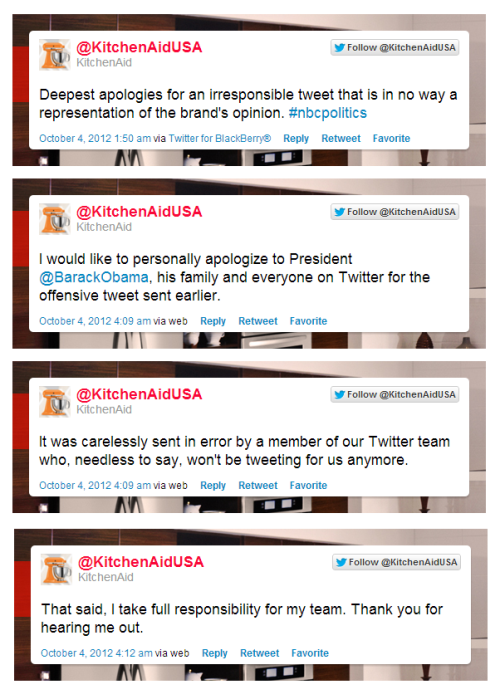
Eight minutes later, the offending tweet was pulled and the first of a series of apology tweets were issued by Cynthia Soledad, the brand manager Click image to see larger version): This is a great example of digital damage control. No half-baked excuses. No “we were hacked” knee-jerk response. A quick reply, with apology, from a real person who can be contacted for more info.
Lesson #2:
Respond quickly, honestly and appropriately.

All of the above: brand damaging post on a social media site; remedial action; full accountability; full transparency — all leading to dousing the fire — happened in less that 2.5 hours.

In social media as in life, accidents will happen. KitchenAid’s response is a lesson for all.


B2B: The Business Side of Social Media

B2B Social Marketing

  • “You can’t do social media from a standing start.”
  • “You don’t have to pull your kimono completely open.”
  • “Content is the catalyst of the social web.”
  • “Be helpful. That’s the magic pixie dust.”
  • “Where there is no margin, there is no mission.”

One of my favorite things about social media is what I call “serendipitous discovery” — the process where you begin by reading something which leads you to something else , and that leads you to another thing, and so on until you wind up finding some tasty nugget that you hadn’t intended to look for at the start. You just follow the trail.

And so this morning, while checking the Twitter stream of a friend of mine, CK Kerley, whose expertise in B2B digital marketing is second to none, I noticed one of her Tweets thanked someone unknown to me (Allen Silveri) for an “awesome article”. Being a fan of awesome articles on B2B marketing I checked out his Twitter stream hoping to find that link and, not finding a reference to an article, went to his agency’s home page, Schubert.com. That led me to their blog and this entry, Social Media Truths in B2B Marketing by Schubert’s PR Director Brian Courtney, regarding insights gleaned while attending the Social Media @ Work Conference in Harrisburg last October.

Whew! Got that? Brian identified five takeaways from speakers at that conference which I believe make sense for anyone engaging in B2B social media: (click for more) Read more of this post

Food for Thought: Adding Social Media to the Menu

After taking time off for summer adventures, misadventures and mishaps (fodder for future posts, no doubt) I came across an article written earlier this year by confessed social media neophyte Bruce Buscel on his attempts to secure PR services for his relatively new restaurant, Southfork Kitchen, located in New York’s vaunted Hamptons on Long Island’s east end. While restaurant centric in nature, there are  lessons to learn for all businesses, big and small, about how social media has changed the landscape for both marketing and public relations.

After two failed attempts to engage a PR firm to support his restaurant’s launch, first with  traditional PR firm that appeared to just go through the (unsuccessful) motions and another with a “foodie” led boutique firm which (on paper) would seem to have been a good fit but ultimately wanted to change the client rather than support it, Bruce  realized that:

“The old P.R. model is as useless as the fax machines on which press releases used to arrive.”

He decided to turn to media firms with expertise in social media. Surveying six of them, he came up with a digital dozen strategies for social media. From those, here are my top five social media strategies for all businesses (paraphrased):

  1. It’s a dialogue– listen and respond
    The first word in social media is “social”. It’s a dialogue, not a broadcast. Listen always; respond frequently; curate connections.
  2. Keep your social media activity current.
    The only thing worse than not being involved in social media is to allow your participation to go stale.
  3. Know your audience.
    Engage them where they already are participating online. Keep in mind that if your customer base is comprised of several distinct audiences that participate on different social networks you’ll need to tailor your content for each.
  4. Assess your progress regularly.
    Like any other business discipline, you need to plan strategy, execute tactics, assess results,  and then modify your plan as indicated. To do so you need to track KPI (Key Performance Indicators) relevant to your specific business and goals (likes, follows, time spent; service issues handled, sales/conversions, etc.) .
  5. Engage a social media pro to get you started and then plan long-term
    Bruce is not alone in wondering how to get up to speed on social media. my advice is, as always, hire a social media professional (one who has successfully been performing social media as a profession for a number of years) to get you started. Then, plan on who will take over that role long-term. Consider bringing your contracted pro in-house if it makes sense for you both.

Bruce concludes,

“What is the sound of irony? We are all in the P.R. business now.”

Indeed.

For Dis-CERN-ing Eyes: The First Photo On the Web

Who are Angela Higney, Michele de Gennaro, Colette Marx-Neilsen and Lynn Veronneau (below, from left to right)? Chances are, you don’t know, but tyou can thank them, in part, every time you view a photo published on the Web.

The First Picture Uploaded to the Web

It seems that those wacky kids at the CERN (Conseil Européen pour la Recherche Nucléaire) Laboratory near Geneva, you know, Tim Berners-Lee and those wacky kids who actually did invent the World Wide web, had an annual talent show called The Hadronic Music Festival.  A popular “girl-group” there, made up of admins and significant others of scientists, was called “Les Horribles Cernettes‘ (LHC). On July 18, 1992 — 20 years ago today — their manager snapped this photo (title added and edited) for use on a soon-to-be-released album cover.

So when Tim Berners-Lee, a LHC fan, needed an image to load on to the latest version of the Web, one that would support photos, he turned to a nearby Mac that had the scanned in  .gif file of the LHC and used that one.

This was significant for two reasons: first, it showed that the Web (up until then used solely for science) could be used for fun; second, it became the precursor to what people like best on the Web today – graphics and visuals. Typically, hardware advances fuel software developments which in turn push the envelope spurring further hardware advances.  Like them or not, but online gaming and, yes, porn pushed hardware and operating system producers to make faster computers with more capacity for graphics and images.

So the next time you view a photo on Flickr, Facebook, Instagram or Pinterest  or on a blog or any on any other page published across the WWW — think about the not-so-horrible Les Horribles Cernettes.

As for LHC? They’re still singing songs and breaking physicists’ hearts.

Oh, and if you think that it’s a coincidence that the worlds largest particle collider, the Large Hadron Collider being used to try to recreate the energy of the big bang that created the universe, has the initials LHC — think again.

Hat Tip: To Abraham Riesman and his article on Mother board

Digital Native, Digitally Naive?

Say, for a moment, that you need to hire someone to lead your company’s nascent social media effort. Quick — picture what that individual looks like. Did an image of a young digital dude (or dudette) come to mind? If so, you’re likely making a mistake.

digital native vs digital immigrantYou’re not alone, the majority of the hiring decision-makers (HR talent recruiters and hiring managers alike) whom I’ve come across, with little personal understanding of social media themselves, believe that this type of job is best filled by a digital native — one for whom the Web and social media have been a part of their lives from early on.

Now, consider these job requirements that I read today on an actual position listing (identifying details altered):

  • Develop a comprehensive social media and community management strategy leveraging your background, experience and knowledge of social media trends and emerging technologies
  • Partner with individuals across the company (management, development and research) to strategize and educate the team on relevant social media techniques to drive adoption and increase thought leadership
  • Manage the day-to-day activities for Facebook, Twitter, Company Blog, LinkedIn and other social media sites
  • Research and write content for social media channels
  • Track and analyze performance of social media programs and activities to drive continuous improvement
  • Manage web and Facebook advertisements
  • Help direct a grassroots street team to promote the [product]
  • Interact with our PR team
  • Monitor trends in social media tools and applications and appropriately apply that knowledge to increasing the use of social media at the company

Did that change your thinking? Sounds like a great job with plenty of opportunity to create strategy, implement tactics and lead the social media initiative for this company for years to come, right?

In fact, this is a great spot for someone like me, a social media professional paid to curate communities, engage with customers, build brands,  develop brand ambassadors and promote products via social media as a career (in my case since 1997).  So why didn’t I immediately submit my application and resume? Because of this next line: Career Level: Early Career (1+ yrs experience) 

Whoa, you want to trust this job — and the reputation of your company, its brand and products (the success of which is essential for the future survival of the company itself) — in the hands of an entry-level individual? Really?

The disconnect comes when companies fail to understand that digital natives lack the necessary business acumen and experience to actually get the job done. They instead believe they need to hire young because, you know, when it comes to social media ‘young people get it’.

That’s a fatal flaw that sets up both the individual hired and the company for failure. There is no substitute for experience when it comes to developing a digital roadmap or building consensus among varied internal stakeholders to insinuate social media throughout the enterprise (the long-term goal for success). And do not for a minute discount the institutional knowledge an experienced person brings to the table regarding what’s worked (and failed) in the past to better be able to recognize the next big thing.

If you want a leader; if you use  phrases like “create strategy”; “implement tactics”; “develop policy” or “lead the organization” as part of the job description, set yourself up for success: hire the digital immigrant —  a social media professional.