Newspapers: Not quite dead yet.
June 6, 2011 Leave a comment
Quick Post: There are 10,000 online newspapers in the world, find out where, here:

… the increasingly jaded musings of a curmudgeon-in-training
June 6, 2011 Leave a comment
Quick Post: There are 10,000 online newspapers in the world, find out where, here:
June 3, 2011 Leave a comment

Image via Wikipedia
There are so many great points about Twitter and language in this article, Is Twitter writing, or is it speech? Why we need a new paradigm for our social media platforms by Nieman Journalism Lab’s Megan Garber I highly recommend you read it in its entirety. But first, here are a few points I found particularly interesting.
What, specifically, is Twitter? Is it writing or is it speech? Or, is it a new communications form entirely. This is not a trivial matter especially as it pertains to the law. Publish damaging text with malice aforethought (as they say) may be libelous — speak disparagingly and it may be considered slander. Different offenses; different remedies and penalties. So what is Twitter? The published word or simply speech made visual? Or, in this world of hybrid pets, plants and cars is it an entirely new species, evolved from technology? (Yes, it is) Read more of this post
May 25, 2011 Leave a comment

Image via Wikipedia
I recently came across this headline on Gather, “Facebook to Pay Users for Viewing Ads?” and my first thought was, “They just don’t get it.” The “it” I am referring to is meaningful user engagement. Yes, Facebook is the biggest social network in the world, with a reported 600 million global users, but sometimes exponential growth is achieved in spite of an organization’s flawed strategy, systems and tactics (remember AOL?).
Let me make this clear, material rewards in exchange for participation on a social network is a long-term losing proposition. Check this cool Dan Pink video on what motivates people, in particular the point that rewarding mechanical functions may work, but once you get beyond “rudimentary cognitive function” it quickly tanks.
Note the mention of the word “engagement”, the current buzzword for why brands and companies should use social media. On social networks, what starts as enthusiastic support for the paying organization by its paid supporters morphs into a feeling of entitlement to that remuneration leading to demands for increased compensation and ending in resentment towards the organization — the exact opposite outcome from what was initially desired.
At that point, you not only have a dissatisfied user, you have one with increased voice and influence who knows how to reach your customers very well.
This is the major flaw behind organizations’ misguided faith in raw social media metrics. Read more of this post
April 25, 2011 Leave a comment
 I’ve seen it first-hand. Despite companies aspirations to openess and full cooperation, there exists a rivalry over “control” of social media with the main combatants Communications/Public Relations (“PR“) and Marketing/Advertising (“Mktg”), leading to internal battles, mistrust and inefficient social media use by both.
And each discipline has valid reasons for wanting this. For PR, social media is a communications, corporate reputation and thought leadership opportunity which will lead to increased, unpaid brand mentions — “earned media”. Mktg views it as an additional opportunity to advance its message to potential and current customers to advance its sales goals.
PR Only or Marketing Only Doesn’t Work
Both have valid points. And the truth is, that utilizing social media by one area without the other is a losing proposition. Organizations that relegate social media to marketing only are losing the vital advantage that social listening; conversational engagement; brand enhancement and thought leadership brings when marshalled by PR. Also, improper use/overuse of social media for purely marketing/advertising purposes can have the opposite effect of turning off your audience to your social media efforts entirely. Similarly, social media use by PR only is a lost opportunity to connect with the audience to convey the value proposition of its goods and services.
And so, in most companies that have realized the advantages of leveraging social media there exists either dual strategies or, worse, no strategy at all as both areas do their own thing. This leads to fierce competition for resources and recognition, departmental distrust, and breakdown in communication (ironic, given social media’s utility for increasing communication).
So Where Should Social Media “Live”?
Of course, in a discipline as young as social media (very few of us have been paid social media practitioners for over 10 years) PR and Mktg are not the only areas where leadership social media mat reside. For my 10 years working at AOL it was in the Product division; during my tenure at BusinessWeek it was part of the Digital division; and when I worked at Bloomberg L.P it lived in Communications, but then later consolidated (to my chagrin) into Marketing.
While not the ultimate answer (see below), if forced to make a choice mine would be PR. The upside potential for understanding audience sentiment; deepening end-user engagement; developing brand supporters, loyalists and defenders; and raising awareness of the organization’s goods, services and leaders is best handled by communications pros.
The one caveat: the need for a social media professional, one who has a visible social media footprint, a and documented success as a paid professional on staff to lead the organization in developing an overall social media strategy; implement best practices; develop internal social media policy; evangelizing social media internally including education and training and working with other departments such as HR and, yes, Marketing to employ social media the right way is an absolute requirement.
The Ultimate Answer
That is not the final answer to the “who owns social media” question — it’s the way most companies should proceed at the early stages of this discipline. The ultimate answer is: the opposites: “No one” and “Everyone“.
A fully integrated, successful social media strategy’s goal should be where both no department feels that they own social media; but every department is responsible for utilizing it as part of a comprehensive, coordinated effort.
April 22, 2011 Leave a comment
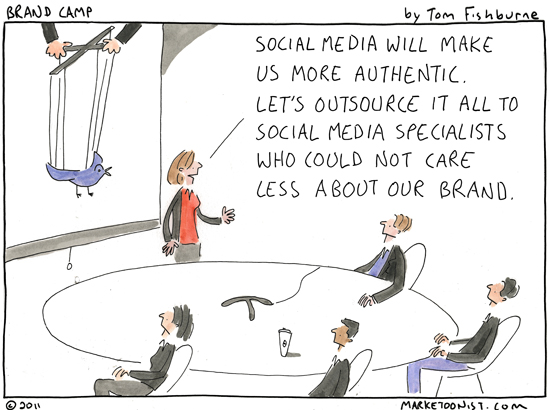
Another in a long line of reasons why companies need to hire an on staff social media professional.





 Bottom of the Food Chain