Happy 100th IBM – and a One Word Lesson for Social Media

Image representing IBM as depicted in CrunchBase

Image via CrunchBase

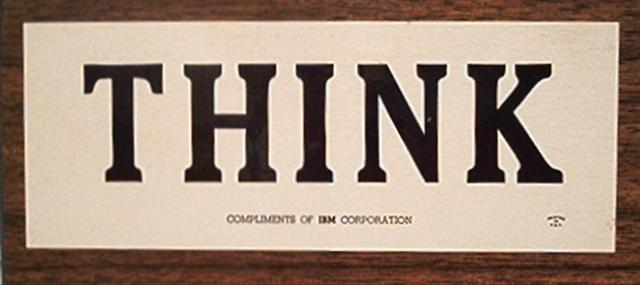
Light the candles (and notify the Fire Marshall) on the cake and sing “Happy Birthday” to IBM as it celebrates its 100th birthday. Despite its many technological accomplishments including the revolutionary punch cards; electric typewriters, mainframes and personal computers, its most significant contribution to social media use may be its iconic company slogan — “THINK”.

On June 16, 1911 four companies merged into the Computing Tabulating Recording Corporation in Endicott, NY creating one of the great American corporations, renamed in 1924 as International Business Machines, IBM. Three years later its iconic leader, Thomas J. Watson, instituted the one-word slogan that both encourages and cautions – THINK.

And that’s the social media lesson for brands and individuals today. Before you send that photo… before you post that angry rebuttal… before you denigrate others (no matter how well deserving)… before you tweet that knee-jerk reaction that , at the time, you are sure is justified… THINK.

Think about how what you send may be received. Think about how what you say can be interpreted. Think about whether what you are about to do maintains accuracy, integrity or transparency — or — just lowers you to the same level as the muckrakers and mudslingers.

Too often, brands have been tarnished, careers ended or major revenue lost, due to the failure to employ a “digital count-to-ten” before publishing on the Web.

It’s not enough being right. It’s not enoughbeing technically correct. In social media, as in all marketing and indeed much of life itself, it’s all about how what you do is perceived. So before you post, tweet, like or digg…
The Five “A”s of PR Crisis Management — Plus a Sixth

ap_anthony_weiner_presser_ll_110606_wgI came across a great article written by Jessica Klieman titled, “5 Tips for Handling a PR Crisis Like Weinergate” (in case you heaven’t heard, it’s the law that all political scandals must have a ‘-gate’ suffix ever since Nixonian times) that gives five tactics for what to do when bad private behavior goes public. I’d like to add a sixth.

Briefly (as Jessica does a great job describing each) the steps are:

  1. Assess – Objectively examine the situation to determine its “legs” and maximum potential impact.
  2. Admit – As I wrote previously, the truth will out. Once a secret is no longer a secret, own the message and ‘fess up.
  3. Address – A full ‘mes culpa’ is required. Make it complete of face the death of a thousand cuts.
  4. Atone – Make things as right as you can especially to those directly affected by your actions.
  5. Adapt – Have a game plan for what happens next. Note: the basis for any game plan should have already been designed as part of your crisis management contingency plan. Waiting until after the fur starts to fly is too late.

I’d add a sixth “A” – Abridge – state the facts; state your case; cover the five “A”s’ and retreat.

While thought noble to stand up and take the slings and arrows thrown your way (perhaps in an attempt to “get it all over with”), just as in most of life when it comes to crisis management, “less is more.” Find that sweet spot of enough time to cover your “A”s (so to speak) then leave. Cut things off too short you run the risk of coming across as abrupt, insincere and unrepentant. Stay too long, you maybe viewed as pathetic or pitiful (“Methinks the politico doth repent too much”). At his presser Weiner went on and on, repeating his message to repetitive questions that morphed from inquiry into condemnation. Is that the lasting image you want associated with an attempt to come clean?

Messed up? ‘Fess up; Retreat; Rebuild.

Accuracy; Integrity; Transparency — A Social Media Lesson For Anthony Weiner (and Everyone)

“… but at the length truth will out.”
– from ‘The Merchant of Venice’ by William Shakespeare

Those words, the bane of politicians, ad men, PR flacks, marketing gurus, titans of business and wayward spouses throughout the ages, are as true today as they were when written 415 years ago.  But instead of waiting for a pamphlet to be printed on a 16th Century mechanical press (the origin of the word “Press” regarding news) and hand delivered, read aloud or nailed on a church door, what happens today can spread  across the globe via social media before the next sunrise.

Those following me for a while know that I am a social media professional who strongly suggests to companies, organizations and yes, politicians, that to take advantage of the vast benefits social media has to offer while avoiding its pitfalls you need two things: 1) to conduct your social media (both brand related and personal use) with accuracy; integrity and transparency and, 2) to consult with or have on board a social media professional to lead the way.

Rep Anthony Weiner courtesy ReutersWhich brings us to U.S. Rep. Anthony Weiner (D-NY), who shorts(sic)-circuited his political plans by engaging in questionable social media and phone-based relationships. For a politician — (one of the few professions where you are expected to always be on the job), this can be a career-breaker causing us to collectively sigh, “What were you thinking?” Regardless, let’s take a look at what he admittedly did and the social media pillars he ignored:

Read more of this post

Is Twitter Text or Speech? The Answer Is: Yes

Emergency "Twitter was down so I wrote my...

Image via Wikipedia

There are so many great points about Twitter and language in this article, Is Twitter writing, or is it speech? Why we need a new paradigm for our social media platforms  by Nieman Journalism Lab’s Megan Garber I highly recommend you read it in its entirety. But first, here are a few points I found particularly interesting.

What, specifically, is Twitter? Is it writing or is it speech? Or, is it a new communications form entirely. This is not a trivial matter especially as it pertains to the law. Publish damaging text with malice aforethought (as they say) may be libelous — speak disparagingly and it may be considered slander. Different offenses; different remedies and penalties. So what is Twitter? The published word or simply speech made visual? Or, in this world of hybrid pets, plants and cars is it an entirely new species, evolved from technology? (Yes, it is) Read more of this post

Updated: Paying Users to View Ads? Facebook Doesn’t Get It

Facebook logo

Image via Wikipedia

I recently came across this headline on Gather, “Facebook to Pay Users for Viewing Ads?” and my first thought was, “They just don’t get it.” The “it” I am referring to is meaningful user engagement. Yes, Facebook is the biggest social network in the world, with a reported 600 million global users, but sometimes exponential growth is achieved in spite of an organization’s flawed strategy, systems and tactics (remember AOL?).

Let me make this clear, material rewards in exchange for participation on a social network is a long-term losing proposition. Check this cool Dan Pink video on what motivates people, in particular the point that rewarding mechanical functions may work, but once you get beyond “rudimentary cognitive function” it quickly tanks.

Note the mention of the word “engagement”, the current buzzword for why brands and companies should use social media. On social networks, what starts as enthusiastic support for the paying organization by its paid supporters morphs into a feeling of entitlement to that remuneration leading to demands for increased compensation and ending in resentment towards the organization — the exact opposite outcome from what was initially desired.

At that point, you not only have a dissatisfied user, you have one with increased voice and influence who knows how to reach your customers very well.

This is the major flaw behind organizations’ misguided faith in raw social media metrics. Read more of this post